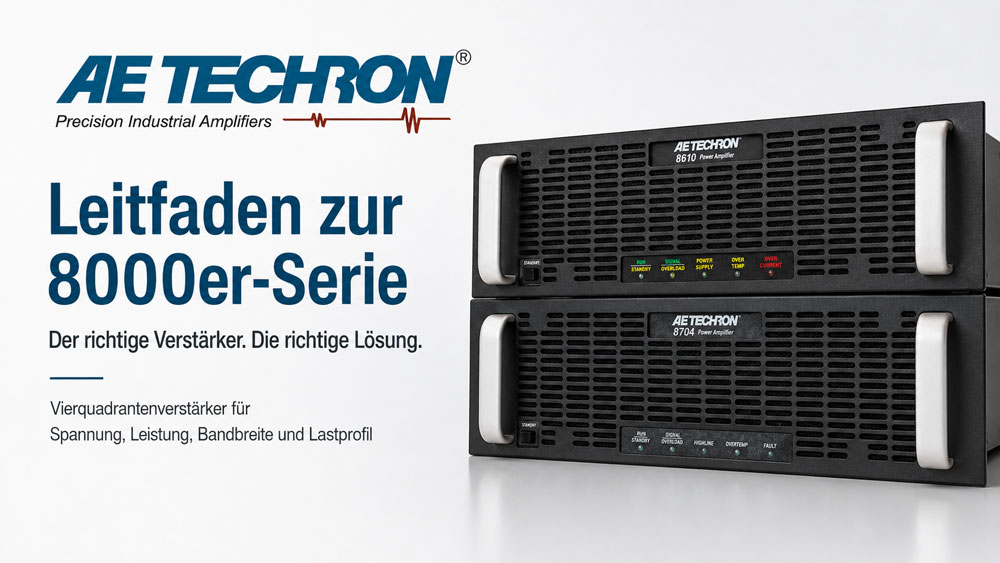
Selecting the right four-quadrant amplifier for the test application
Four-quadrant amplifiers are used in testing and power supply systems where an amplifier must not only deliver energy to a load but, depending on the operating condition, also absorb returned energy. Selecting an appropriate solution therefore requires several electrical and application-specific parameters to be considered together.
The AE Techron 8000 Series provides a scalable amplifier portfolio for different test requirements. Applications range from transient overvoltage and EMC testing to ripple, dynamic and high-frequency tests operating at frequencies up to 250 kHz.
Voltage, power, bandwidth and load profile as selection criteria
The required amplifier power alone is not sufficient for reliable system dimensioning. The decisive factor is the combination of voltage, power, bandwidth and the electrical load profile.
Pulsed loads place different demands on an amplifier than continuous high-power operation. Reactive loads can return energy to the system, while fast transients and ripple signals require appropriate dynamic performance and bandwidth. AE Techron therefore assigns each amplifier series to a specific application profile.
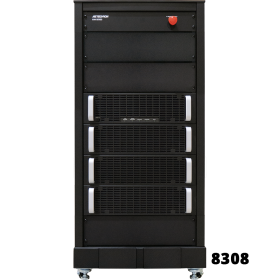
8300 Series for pulse-intensive applications
The 8300 Series is positioned as an economical solution for pulse-intensive test applications. The provided information specifies requirements up to 200 Vp.
This series is particularly relevant where short-duration peak loads are the primary consideration and neither continuous high-power operation nor a frequency range extending to 250 kHz is required. Detailed output current, continuous power and bandwidth specifications are not provided in the supplied information.
8500 Series for reactive loads and transient testing
The 8500 Series addresses reactive loads, transient testing and EMC applications. AE Techron specifically identifies DO-160 Section 16 and MIL-STD-704 as relevant test contexts.
The series is therefore applicable to test benches that must reproduce electrical supply conditions and disturbances for avionics or other safety-critical electrical systems. The required voltage and current waveforms, together with the behaviour of the connected load, must be evaluated during product selection.
8600 Series for continuous high-power operation
The 8600 Series is designed for continuous high-power applications, fast rise times and EMC compliance testing in the context of IEC 61000.
It is therefore intended for test systems in which the required power must be maintained throughout extended test sequences rather than delivered only for short periods. Fast rise times are particularly relevant when reproducing dynamic voltage and current waveforms accurately.
Model-specific power ratings, voltage ranges and bandwidths are not specified in the provided information and must be assessed against the actual test requirements.
8700 Series for high-frequency testing up to 250 kHz
The 8700 Series is intended for test applications requiring higher frequencies up to 250 kHz. AE Techron identifies ripple testing, dynamic testing and capacitor ripple testing as typical applications.
In these applications, the amplifier must reproduce time-varying signals with suitable dynamic performance. In addition to maximum frequency, the required amplitude, load behaviour and test duration are therefore relevant to system dimensioning.
Typical applications of the AE Techron 8000 Series
- Transient overvoltage testing: Generation of defined short-duration voltage conditions for development and qualification tests.
- EMC testing: Electrical immunity and compliance testing within the context of the applicable standard.
- Reactive load testing: Supplying and driving loads with capacitive or inductive behaviour.
- Avionics testing: Test applications related to DO-160 Section 16 and MIL-STD-704.
- Continuous high-power testing: Test sequences requiring sustained amplifier output power.
- Ripple and dynamic testing: Reproduction of time-varying signals at frequencies up to 250 kHz.
- Capacitor ripple testing: Evaluation of components under defined dynamic current or voltage conditions.
Technical criteria for system dimensioning
Before selecting an amplifier series, the test bench requirements should be specified as completely as possible. Selecting a unit solely according to maximum power can result in unnecessary oversizing or cause important dynamic requirements to be overlooked.
- Voltage requirement: Required continuous voltage and short-duration peak values.
- Power requirement: Continuous power and peak power required during transient events.
- Load profile: Resistive, inductive, capacitive or combined behaviour of the test load.
- Operating mode: Pulsed operation, repeated transients or continuous high-power operation.
- Bandwidth: Highest signal frequency and required rise and fall times.
- Test standard: Required waveforms and test levels according to the applicable standard.
- System dimensioning: Coordination of the amplifier with the generator, measurement system, protection concept and test load.
Balancing technical performance and system cost
Application-specific amplifier selection allows a test system to be dimensioned according to the electrical and dynamic characteristics actually required. This helps avoid unnecessary performance reserves and keeps system costs under control.
At the same time, insufficient dimensioning must not cause the amplifier to operate outside its intended range during peak loads, with reactive loads or during fast signal transitions. Selection should therefore be based on the complete test profile rather than on a single maximum value.
EMCO supports technical amplifier selection
EMCO Elektronik is the local contact for AE Techron products in Germany and Austria. EMCO specialists support users in assessing their test requirements and selecting an appropriate amplifier series.
The evaluation can take voltage, power, bandwidth, operating mode, load behaviour and the relevant standards context into account. The objective is to select an amplifier solution that matches the technical test requirement without unnecessarily oversizing the test system.