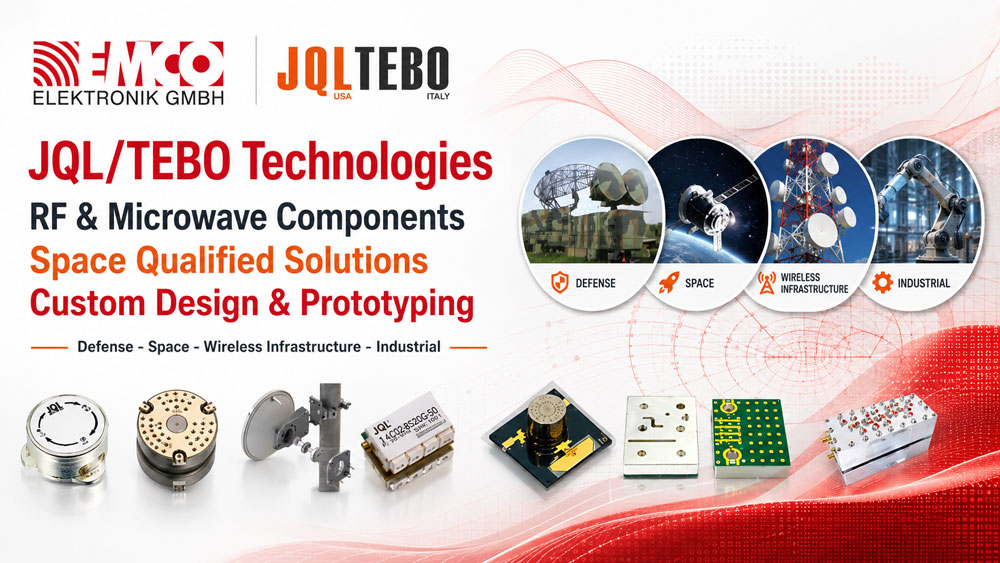
JQL/TEBO Technologies joins the EMCO Elektronik portfolio
EMCO Elektronik is expanding its RF components and microwave technology offering with the products and engineering capabilities of JQL/TEBO Technologies. EMCO is therefore the technical sales partner and point of contact for customers in Germany, Austria and Switzerland.
The expanded portfolio is particularly relevant to development engineers, system integrators, technical purchasing teams and project managers who require more than an individual standard component. It combines an extensive range of passive RF and microwave components with custom engineering, prototype production, and the design and assembly of electronic equipment.
From a customer perspective, this combination is relevant when electrical requirements, mechanical integration, thermal conditions and quality requirements must be considered together. Instead of selecting a component solely on the basis of its frequency range, users can consider its complete integration into the RF signal chain and the associated electronics.
Two complementary areas of expertise
The offering combines two complementary areas of expertise. JQL Technologies designs and manufactures RF and microwave components including filters, isolators, circulators, couplers, power dividers and other passive devices. JQL TEBO complements this range with the design and manufacture of electronic assemblies and equipment.
TEBO has experience in the design and assembly of printed circuit boards and electronic equipment using SMT and THT technologies. The development process can include feasibility analysis, component selection, electronic design, and preparation for manufacturing and testing.
For custom systems, this provides a continuous project workflow:
- Definition of electrical and mechanical requirements: Specification of the required RF function, interfaces, mechanical format and operating conditions.
- Selection or adaptation of RF components: Use of an existing standard product or development of an application-specific variant.
- Electronic assembly development: Integration of the RF component into a PCB, subsystem or complete electronic device.
- Prototype production and verification: Manufacture of initial samples and evaluation of their electrical and functional characteristics.
- Transfer to manufacturing: Preparation of repeatable SMT, THT or mixed-technology production processes.
Passive components for different functions within the RF signal chain
The JQL portfolio includes numerous building blocks used to route, divide, combine, filter, isolate or terminate RF signals. Each product family fulfils a different role within transmit, receive or distribution architectures.
- Cavity and ceramic filters: The range includes bandpass, high-pass, low-pass and notch filters, as well as duplexers, diplexers, triplexers, quadplexers, multiplexers, DTMA solutions, PIM testing filters and switch filter banks.
- RF isolators: Non-reciprocal ferrite devices used to isolate stages within an RF signal chain. They may, for example, help decouple a sensitive source or amplifier stage from reflected power.
- RF circulators: Multi-port non-reciprocal devices that route RF power from one port to another in a defined direction. Their exact function depends on the external connections and system architecture.
- Directional couplers and tappers: Devices used to extract or distribute a defined proportion of RF power for monitoring, measurement or distribution functions.
- Power splitters and combiners: Reactive and Wilkinson structures for dividing or combining RF signals.
- Hybrid combiners and hybrid matrices: Devices for signal distribution and combining applications in which defined phase relationships may be relevant in addition to power distribution.
- Low-PIM components: These include attenuators, terminations, directional couplers, DC blocks and bias tees for applications with demanding passive intermodulation requirements.
- DC blocks and bias tees: Devices used to separate or combine RF and DC paths.
- Terminations and CVD diamond terminations: Components designed to absorb RF power. Permissible power and thermal conditions must be checked individually for each model.
- Waveguide components: The portfolio includes waveguide versions of isolators and circulators as well as associated adapters.
The product database includes solutions for different frequency ranges, power levels and integration formats. Specific insertion loss, isolation, return loss, VSWR, average power, peak power and operating temperature values are model-dependent and must be evaluated using the relevant datasheet.
Coaxial, drop-in, surface-mount, microstrip or waveguide integration
For isolators and circulators in particular, the electrical specification is only one part of the selection process. JQL offers these ferrite components in several mechanical and electrical integration formats:
- Coaxial: Suitable for integration into cabled RF paths or modular systems with defined coaxial interfaces.
- Drop-in: Intended for direct mechanical and electrical integration into an RF module or machined housing.
- Surface mount: Suitable for compact PCB integration and automated assembly processes.
- Microstrip: Intended for integration into planar RF circuits with an application-specific PCB and housing design.
- Waveguide: Suitable for waveguide systems in corresponding microwave and millimetre-wave applications.
The selected format affects the required space, the transitions between PCB, housing and RF interface, thermal behaviour and achievable manufacturing repeatability. For drop-in, microstrip and surface-mount components, the PCB or carrier layout must be treated as part of the RF function.
The technical assessment must therefore consider more than the nominal S-parameters of the component. The measurement reference plane, grounding concept, housing modes, mechanical tolerances and heat dissipation under actual operating conditions are also important.
Custom design, prototype production and transfer to series manufacturing
In addition to standard products, JQL offers custom development of components and subsystems. This is particularly relevant when an existing product does not fully meet the required frequency coverage, bandwidth, rejection, isolation, power handling, package size or interface.
According to the manufacturer, its R&D team can convert product concepts into prototypes and subsequently develop them for series production. JQL states a typical prototype lead time of two to four weeks. In individual cases, product datasheets may be prepared within 48 hours and initial samples may be supplied in as little as three days. These are supplier statements and depend on the specification, complexity, material availability and testing requirements of each project.
A reliable custom design request should define the following requirements as early as possible:
- Electrical parameters: Frequency range, bandwidth, insertion loss, isolation, return loss, rejection or coupling factor.
- Power profile: Average power, peak power, pulse width, duty cycle and permissible forward and reverse power.
- Linearity: Permissible intermodulation products and any Low-PIM requirements.
- Mechanical integration: Dimensions, footprint, mounting arrangement, connectors, port orientation and maximum height.
- Thermal conditions: Operating temperature, cooling concept, thermal contact area and available heat dissipation.
- Environmental requirements: Vibration, shock, humidity and other project-specific stresses.
- Testing and documentation: Measurement data, traceability, acceptance criteria and required qualification evidence.
TEBO can complement component development with the design and assembly of SMT and THT electronics. The Italian organisation also describes the development of dedicated test benches when existing functional or in-circuit test methods are insufficient for the assembly concerned.
Quality control and traceability
In RF components, small variations in materials, geometry, assembly or contacting can produce measurable changes in insertion loss, isolation, matching or passive intermodulation. Controlled manufacturing and test processes are therefore particularly important for series products and qualification-driven projects.
JQL lists ISO 9001, ISO 14001 and AS9100 certifications for its Mundelein facility in the United States. The manufacturer also describes a vertically integrated manufacturing model that includes in-house ferrite production.
The facilities identified for development, manufacturing and verification include:
- X-ray inspection: Non-destructive inspection of internal structures and connections.
- Temperature-shock testing: Evaluation of components and connections under rapid temperature changes.
- ICT and electrical testing: Inspection of electronic assemblies and electrical product characteristics.
- Anechoic chamber: For selected RF and electromagnetic measurement tasks.
- PIM testing station: For passive intermodulation testing of appropriately specified components.
- Power testing: Measurements under the specified RF power conditions.
- Vibration testing: Evaluation of mechanical stresses.
JQL also describes batch-level material traceability using barcodes and an ERP/MES system. According to the manufacturer, complete electrical testing is carried out during final quality assurance and the resulting test plots are stored. However, the exact test plan, measurement uncertainty and acceptance limits remain product- and project-specific.
Space Qualified components require project-specific qualification
The EMCO announcement identifies Space Qualified isolators, circulators and filters in different mechanical formats. For space and other high-reliability applications, however, this designation alone is not sufficient to determine suitability for a specific programme.
The available information does not define a single qualification level applicable to the entire portfolio. The relevant standards, screening levels, radiation requirements, material restrictions, lot acceptance tests and documentation packages are also not specified as general portfolio characteristics.
The following points should therefore be agreed at an early stage for a space programme:
- Mission profile: Mission duration, orbit, temperature cycling and mechanical loads.
- Electrical derating: Permissible RF power and thermal loading with the required margins.
- Material and process requirements: Traceability, permitted materials, finishes and manufacturing processes.
- Screening and qualification: Required test sequences, sample quantities and acceptance criteria.
- Documentation: Test reports, material records, configuration control and approval status.
- Lot-specific verification: Definition of whether type qualification, lot testing or individual unit testing is required.
The applicable space qualification must therefore be evaluated using the specific part number and programme specification. An AS9100-certified facility does not automatically constitute product- or mission-specific qualification.
Typical applications and technical selection with EMCO
JQL/TEBO addresses applications in wireless infrastructure, public safety, DAS, radio links, radar, SatCom, defence and industrial electronics. Depending on the system, the requirement may involve individual passive components, custom RF assemblies or complete electronic subsystems.
- Wireless infrastructure and DAS: Signal filtering and distribution, including Low-PIM components in power-carrying signal paths.
- Public-safety communications: Frequency-selective components, couplers and distribution structures for relevant radio infrastructures.
- Radio links: Compact isolators, filters and other passive components for microwave radio systems.
- Radar: Ferrite devices, filters, waveguide components and signal distribution devices for project-specific architectures.
- SatCom: Filters, multiplexers, isolators, circulators and waveguide components for ground-based or other satellite communication systems.
- Defence and space: Custom components and assemblies for which qualification, traceability and documentation form part of the technical specification.
- Industrial electronics: Design, assembly and testing of custom SMT and THT electronic assemblies.
EMCO supports customers in defining the required RF function, selecting an appropriate component family and coordinating custom requirements. This includes clarification of frequency range, power, isolation, insertion loss, mechanical format, interfaces, thermal integration and the required testing or qualification scope.
JQL/TEBO therefore adds more than further passive RF and microwave components to the EMCO portfolio. The combination of component engineering, electronic design, prototype production and manufacturing also provides a basis for projects in which a standard component alone is not sufficient.