Blog navigation

Latest posts

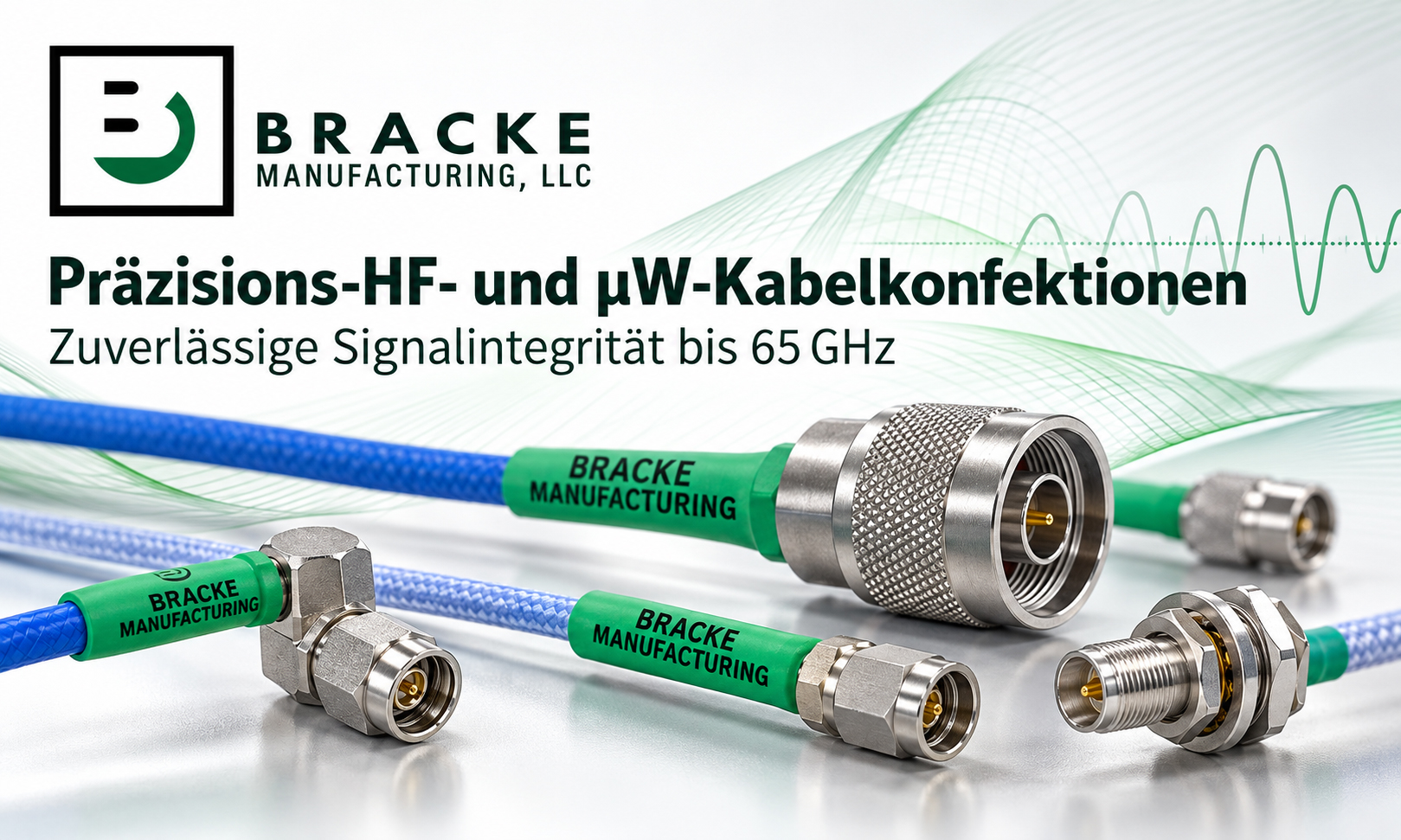
BRACKE RF Cable Assemblies up to 65 GHz: Signal Integrity
15 views

Explore BRACKE precision RF cable assemblies up to 65 GHz. Learn about signal integrity, connectors, insertion loss...

View full article
AE Techron 3110A: Automated EMC Testing up to 1 MHz
93 views

The AE Techron 3110A automates low-frequency EMC testing from DC to 1 MHz with more than 3,700 integrated automotive...

View full article
MonitEM-IoT: 24/7 EMF monitoring for Smart Cities and utilities
125 views

MonitEM-IoT continuously monitors RF fields up to 8 GHz and connects distributed measurement points using LTE-M and...

View full article
VIAVI CX300: TETRA RF and protocol testing in one instrument
169 views

The VIAVI CX300 now supports TETRA MS Protocol Testing, combining RF measurements and functional protocol tests for...

View full article
TRU RF Cables Become APTIV: What Changes for Customers
213 views

Winchester Interconnect is being integrated into Aptiv. Discover what the APTIV branding means for established...

View full article

BRACKE RF Cable Assemblies up to 65 GHz: Signal Integrity

16 Views
 

BRACKE HF-Kabelkonfektionen bis 65 GHz: Präzision im Signalpfad

BRACKE Precision RF Cable Assemblies: Reliable Signal Transmission up to 65 GHz

In modern RF and microwave engineering, the quality of a signal connection plays a critical role in overall system performance. At high frequencies, even small discontinuities in the signal path can affect transmission quality and the repeatability of measurement results.

With its precision and ultra-precision RF cable assemblies, BRACKE Manufacturing offers interconnection solutions for demanding applications in RF test and measurement, communications and system integration.

The portfolio includes configurations with frequency limits ranging from 18 GHz up to 65 GHz. These cable assemblies are designed for low-loss, stable signal transmission and are offered with different connector interfaces, cable diameters and mechanical configurations.

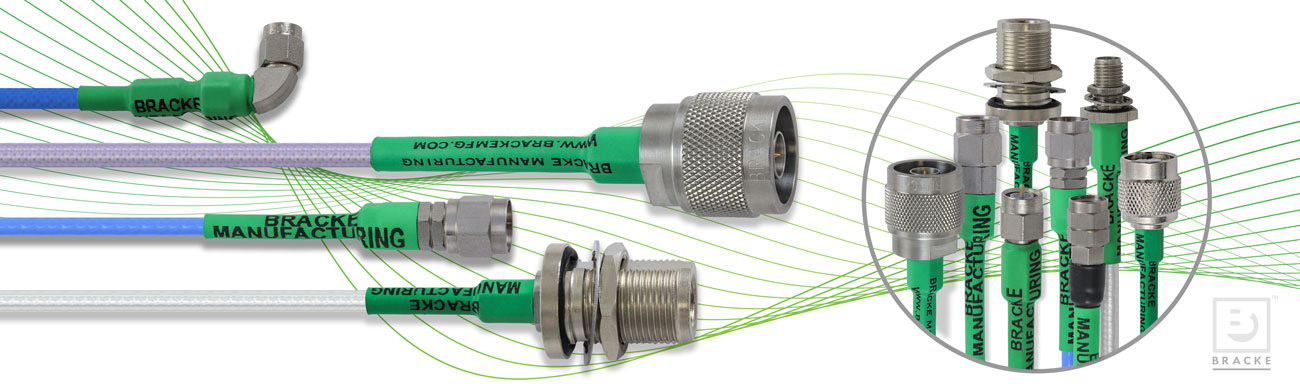
BRACKE precision RF cable assemblies featuring straight, right-angle and bulkhead connector configurations

Selecting the appropriate assembly for each application is essential. The maximum frequency rating of 65 GHz does not automatically apply to every available cable and connector combination.

Why RF Signal Path Quality Becomes More Critical at Higher Frequencies

A coaxial cable is more than an electrical connection between two instruments. It is an RF transmission line whose electrical properties can directly influence system performance and the measurement uncertainty budget.

As frequency increases, several physical effects become increasingly important, including frequency-dependent conductor and dielectric losses, reflections at impedance discontinuities and changes in electrical characteristics resulting from mechanical stress.

Several parameters are particularly relevant when evaluating an RF cable assembly:

  • Insertion Loss (S21): Describes signal transmission between the input and output. Higher insertion loss reduces the signal level available at the device under test or receiver.
  • Return Loss and VSWR: Describe impedance matching quality. Mismatches generate reflections and can introduce frequency-dependent amplitude variations in a measurement setup.
  • Amplitude and Phase Stability: Are especially important when cables are moved or repeatedly connected. Variations in electrical characteristics may affect measurement repeatability.
  • Mechanical Characteristics: Cable diameter, minimum bend radius, connector geometry and mechanical stress influence integration and long-term handling.

These parameters are general technical evaluation criteria. Their actual values must be verified against the specifications of the selected cable assembly.

Flexible Configurations for Different RF Interfaces

BRACKE Manufacturing offers precision RF cable assemblies in different electrical and mechanical configurations, allowing engineers to address various instrument interfaces, installation constraints and cable routing requirements.

The product family includes the following features:

  • Frequency Coverage: Product variants with upper frequency limits ranging from 18 GHz to a maximum of 65 GHz.
  • Precision Connectors: 1.85 mm, 2.4 mm and 2.92 mm connector interfaces for corresponding high-frequency applications.
  • Additional Connector Types: N-Type, SMA and TNC for different RF applications.
  • Connector Geometries: Straight and right-angle configurations, as well as bulkhead versions.
  • Cable Configurations: Multiple cable diameters and assembly configurations for different mechanical integration requirements.

Connector selection becomes particularly important at high frequencies. The electrical performance of a cable assembly depends on the combined characteristics of the cable, connectors and transitions. The specified upper frequency limit must therefore be considered for the complete assembly rather than for an individual connector alone.

Mechanical configuration also matters. Right-angle connections can simplify cable routing in restricted spaces, while bulkhead configurations provide options for integration into instrument enclosures and RF systems.

Typical Applications in RF Testing, Development and Communications

BRACKE cable assemblies address applications requiring defined and repeatable RF connections. They are particularly relevant in laboratory environments, research and development activities and the integration of high-frequency subsystems.

  • Vector Network Analysis (VNA): Connections between measurement instruments and the Device Under Test (DUT) during RF component characterization. Cable characteristics must be considered during calibration and measurement.
  • RF and Microwave Test Setups: Signal routing between signal generators, devices under test and suitable measurement instruments.
  • Research and Development: Construction and characterization of RF assemblies, transmission paths and individual components.
  • Communication Systems: RF interconnections within the development, testing and integration of communication hardware.
  • System Integration: Connections between modules, instruments and interfaces, including installations requiring bulkhead connections or restricted cable routing.

In repeatable measurement environments, special attention should be paid to changes in cable routing, connector mating and mechanical stress, as these factors may influence the comparability of measurement results.

Selecting the Right RF Cable Assembly: Key Technical Considerations

Selecting a suitable cable assembly involves more than identifying the maximum operating frequency. Electrical and mechanical requirements must be assessed together to ensure proper system integration.

  • 1. Frequency Range: Does the selected cable assembly cover the entire operating or measurement frequency range?
  • 2. Insertion Loss and Matching: What frequency-dependent Insertion Loss, Return Loss and VSWR values are specified for the selected cable length and connector configuration?
  • 3. Connector Interfaces: Are connector type, gender, geometry and mechanical interfaces compatible with the existing instruments?
  • 4. Cable Length and Mechanical Integration: What routing is required, and what limitations arise from cable diameter, minimum bend radius and available installation space?
  • 5. Measurement Repeatability: What requirements apply to amplitude and phase stability, repeated mating cycles and mechanical movement?
  • 6. Operating Conditions: What are the required power handling capability, operating temperature range and environmental characteristics?

The supplied product information does not provide model-specific numerical values for Insertion Loss, VSWR, phase stability, minimum bend radius or power handling. These parameters should be checked against the relevant product specifications during the selection process.

For demanding measurement setups, it is also advisable to evaluate the complete signal path, including cables, interconnections and additional RF components, as part of the measurement uncertainty assessment.

Considering the Complete RF Signal Path: Additional Precision Components

A reliable RF interconnection frequently consists of more than a single cable assembly. Adapters, connectors and attenuators may perform additional functions within measurement and communication systems.

Alongside its precision RF cable assemblies, BRACKE Manufacturing offers complementary RF and microwave components:

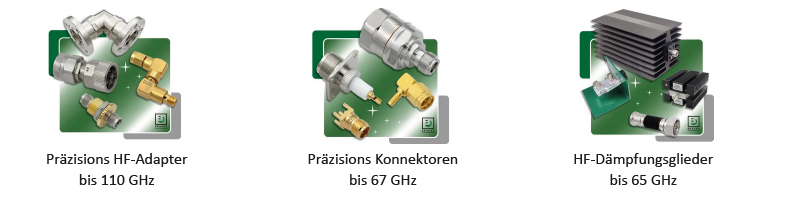
BRACKE precision RF adapters up to 110 GHz, precision connectors up to 67 GHz and RF attenuators up to 65 GHz

  • Precision RF Adapters up to 110 GHz: For interconnecting and adapting different RF interfaces, depending on the selected model.
  • Precision RF Connectors up to 67 GHz: For implementing and integrating high-frequency connections.
  • RF Attenuators up to 65 GHz: For controlled signal attenuation within suitable RF signal paths.

When combining these components, engineers must consider that every additional interconnection can influence insertion loss and impedance matching. The maximum frequency rating of an individual component does not automatically define the usable frequency range of the complete assembled signal path.

Evaluating the complete RF chain is therefore important for repeatable measurements and reliable system operation.

EMCO Elektronik: Your Partner for BRACKE RF and Microwave Solutions

As a contact for BRACKE Manufacturing products and solutions, EMCO Elektronik assists customers in selecting suitable RF and microwave components for their technical applications.

The selection process focuses on application-specific requirements, including frequency range, connector interfaces, electrical performance, mechanical integration and compatibility with existing test and measurement systems.

With expertise in RF and microwave technology, RF test and measurement and system integration, EMCO helps customers evaluate suitable cable assemblies and complementary components for their complete RF signal paths.

Planning an RF measurement setup or looking for a suitable cable assembly? Contact the EMCO team to discuss your technical requirements and explore the available BRACKE solutions.