


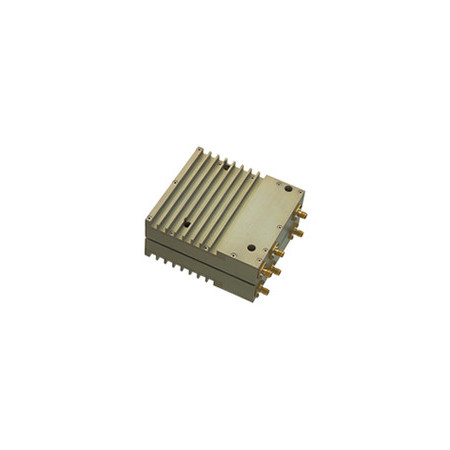

RF Hybrid Combiners & Matrices – Low-PIM and multiband configurations, 0.422–0.424 GHz | JQL Electronics / Dorado

JQL Hybrid Combiners and Hybrid Matrices for RF, DAS and wireless applications, including multiband configurations, Low-PIM models and custom designs.
The JQL Technologies Hybrid Combiners and Hybrid Matrices are passive RF components for combining and distributing multiple RF signal paths and frequency bands. The product family includes both Hybrid Combiners with defined electrical characteristics and multiband matrices covering several cellular frequency bands.
Available models differ in terms of frequency band, insertion loss, isolation, return loss, PIM and power. The Hybrid Matrices combine several frequency bands within a single configuration.
Advantages
- Hybrid Combiners and Hybrid Matrices: two product groups for different RF signal architectures.
- Multiband configurations: matrix models covering multiple cellular bands within one configuration.
- Low-PIM versions: PIM values are specified on selected models.
- High isolation: up to 70 dB on the listed JFCC0422T0424NF.
- Broadband Hybrid Combiners: models covering 2 to 6 GHz and 4 to 8 GHz.
- Multiple power configurations: model-dependent power specifications.
- Custom design: custom configurations according to type, frequency band, insertion loss, rejection and isolation requirements.
Key features
- Product types: Hybrid Combiner and Hybrid Matrix
- Hybrid Combiner frequency ranges: 0.422–0.424 GHz, 2–6 GHz and 4–8 GHz
- Hybrid Matrices: multiband configurations covering LTE700, CELL800, PCS, AWS, WCS, CDMA & GSM, LTE1800 and WCDMA
- Insertion loss: model dependent
- Isolation: up to 70 dB on listed Hybrid Combiner models
- Return loss: model dependent
- PIM: specified on selected Hybrid Combiner and Hybrid Matrix models
- Power: model dependent on Hybrid Combiner models
Typical applications
- DAS – Distributed Antenna Systems
- Public safety radio systems
- Radar
- Radio links
- SatCom
- Wireless communication systems
Additional information
The product family is divided into Hybrid Combiners and Hybrid Matrices. The Hybrid Combiner range includes a narrowband 0.422–0.424 GHz configuration as well as broadband models covering 2 to 6 GHz and 4 to 8 GHz.
The JCX1284 and JFCC0703T2170DF Hybrid Matrices combine several defined cellular bands. They therefore provide different multiband configurations with model-dependent insertion loss and PIM specifications.
Hybrid Combiner model comparison
| Part Number | Band 1 (GHz) | Band 2 (GHz) | Insertion Loss | Isolation | Return Loss | PIM (dBc) | Power |
|---|---|---|---|---|---|---|---|
| JFCC0422T0424NF | 0.422–0.424 | 0.422–0.424 | 4 | 70 | 20 | 80 (4x47dBm) | 4x100 |
| HC-2000T6000-S5 | 2.0–6.0 | 2.0–6.0 | 1.0 Typ / 1.5 Max | 20 | 15.6 Typ / 12.8 Min | 50 | |
| HC-4000T8000-S5 | 4.0–8.0 | 4.0–8.0 | 0.35 | 18 | 17 | 50 |
Hybrid Matrices model comparison
| Part Number | Band 1 | Band 2 | Band 3 | Band 4 | Band 5 | Insertion Loss | PIM (dBc) |
|---|---|---|---|---|---|---|---|
| JCX1284 | LTE700 | CELL800 | PCS | AWS | WCS | 9 | 130 (2x43dBm) |
| JFCC0703T2170DF | LTE700 | CDMA&GSM | LTE1800 | WCDMA | 1.2 | 150 (2x43dBm) |

Related articles
 BRACKE Manufacturing now at EMCO: RF and Microwave Components